
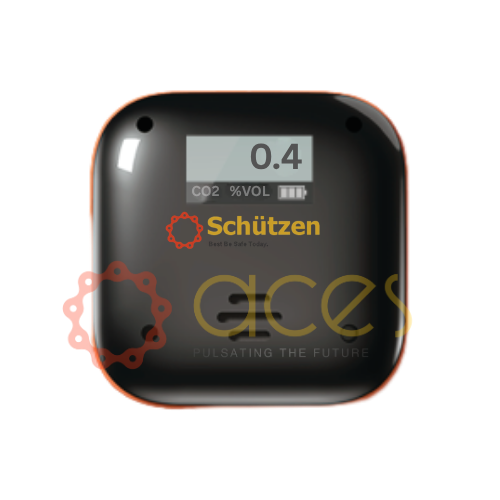
Schützen Klein-H1600 Carbon Dioxide Personal Gas Monitor is the ideal solution for 2 years hassle-free personal detection.
Measuring Range: 0 to 5%
The Schützen Klein-H1600 CO2 Personal Gas Monitor is a state-of-the-art personal gas detection device designed to accurately measure carbon dioxide (CO₂) concentrations in various industrial, commercial, and laboratory settings. This device prioritizes worker safety and environmental monitoring by providing real-time data and alerts for CO₂ levels.
Carbon dioxide is a naturally occurring gas essential for life, but elevated concentrations in confined spaces or industrial environments can pose serious health risks. Excessive exposure to CO₂ can lead to dizziness, unconsciousness, and even asphyxiation in extreme cases. Therefore, continuous monitoring is crucial in workplaces where CO₂ is produced, stored, or used in large quantities.
Schützen Klein-H1600 CO2 Personal Gas Monitor features a highly accurate IR sensor, ensuring precise and stable CO₂ measurement. Its compact, lightweight design makes it easy to carry, while its durable construction ensures reliable performance even in harsh environments. The device is engineered to provide instant visual, audible, and vibration alerts when dangerous CO₂ levels are detected, enabling users to take immediate safety measures.
This gas detector is an essential safety tool for industries such as breweries, wineries, agriculture, food storage, laboratories, and confined space operations. With long battery life, user-friendly operation, and robust alarm systems, the Schützen Klein-H1600 CO2 CO2 Personal Gas Monitor is a trusted choice for professionals who prioritize workplace safety and compliance with gas exposure regulations.
Applications:
The Schützen Klein-H1600 CO2 CO2 Personal Gas Monitor is widely used in various industries where carbon dioxide exposure poses a risk, including:
-
Agriculture & Greenhouses (Monitoring CO₂ levels for plant growth)
-
Breweries & Wineries (CO₂ exposure during fermentation)
-
Cold Storage & Food Industry (Preventing CO₂ buildup in enclosed areas)
-
Confined Spaces (Ensuring worker safety in underground tunnels, tanks, etc.)
-
Laboratories & Research Facilities (Handling CO₂ in scientific applications)


